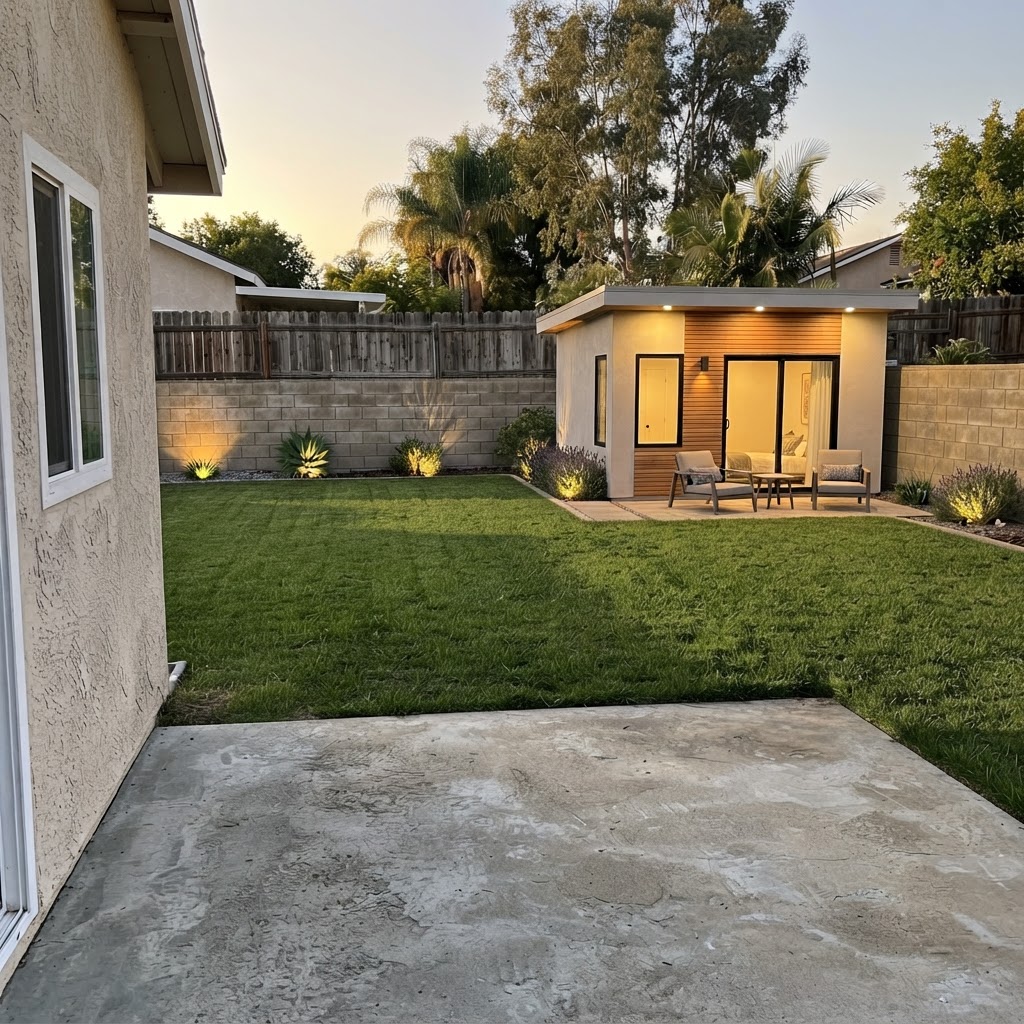
The short version
An ADU is one of the largest projects a homeowner will ever take on, and almost nobody starts it by calling a builder. They start by reading. By the time they search for an ADU builder in Orange County or Los Angeles, they already have three questions: can I build one on my lot, which kind should I build, and how long will the city take. A website that answers those three, in plain language, gets the call. One that shows a few finished units and a phone number gets bookmarked.
Why ADU buyers research for so long
State ADU law has been rewritten repeatedly. HCD's ADU Handbook describes changes between 2023 and 2026 that "further reduced barriers" to building ADUs and junior ADUs 1. That is good for your business, and it also means homeowners arrive with half-remembered rules from a news story, a neighbor or a video. Your website is the place to replace that with your process.
What the site has to answer
1. "Can I build one on my lot?" This is the first question and the one most ADU sites skip. Do not answer it with a table of setbacks; rules vary by city and change often. Answer it with a feasibility request: address, lot type, what is on the property now (detached garage, back house, open yard), and a photo. Then say what happens next and how fast you reply.
2. "Which kind of ADU should I build?" Give each unit type its own page, because each one is a different buyer:
- Detached backyard units — the classic "cottage in the back" project.
- Garage conversions — state law allows ADUs in detached garages, and a local agency must review the demolition permit for a detached garage being replaced with an ADU at the same time as the ADU permit 1. Homeowners with an unused garage often do not realize it is a starting point.
- Back-house conversions — an existing structure brought up to a rentable apartment.
- Attached additions — for owners who want the space connected to the main house.
3. "How long does the city take?" Under state law, a local agency must approve or deny a complete ADU application within 60 days, and the permit is considered without discretionary review or a hearing 1. Say that, and say what it is not: the 60 days start from a complete application, after design and plans, and construction follows. A simple step-by-step timeline — site visit, plans, submittal, corrections, approval, build, final inspection — does more to build trust than any promise of speed.
4. "Do you have plans ready?" Local agencies have been required to run a program for preapproved ADU plans since January 1, 2025, and an application for a detached ADU using a preapproved plan must be approved or denied within 30 days 1. If you build from preapproved or permit-ready plans, give them a page. It is one of the strongest reasons a homeowner has to pick you.
5. "Can I rent it out?" Rental income is the reason many homeowners build, and multigenerational housing is the other. Treat them as separate audiences with separate pages. Be accurate about short-term rentals: local agencies may require ADUs to be rented for terms longer than 30 days 1, so do not market a unit as a vacation rental.
6. "What will it cost, and how do people pay for it?" If you are comfortable showing ranges, show them with what drives the number: size, unit type, site work, utilities. If you are not, explain the inputs and what your estimate includes. Either way, put financing options where homeowners see them before they have to ask.
Show the unit on their lot
The hardest thing for an ADU buyer is picturing a building that does not exist in a yard they know by heart. Floor plans and photos of someone else's property only go part of the way.
An AI visualizer on your website closes that gap. The homeowner uploads a photo of their backyard, garage or back house, picks the unit type, size and style, and sees a concept of the ADU on their own lot — then sends you the request with that photo and every choice attached. It is a concept, not a design or a permit drawing, and should always be labeled that way. But a homeowner who has seen a one-bedroom unit behind their own fence is a much more serious inquiry than one who filled in a blank contact form. See how the visualizer works for ADU builders.
Be findable where you build
ADU permits are pulled city by city, and homeowners search that way: "ADU builder Irvine," "garage conversion Long Beach." Google's local ranking guidance turns on relevance, distance and prominence 2. A service-area page for each city you actually build in, with your own projects from that city, is more relevant to those searches than one page covering all of Southern California. Keep your Google Business Profile's services and areas matching the site.
Make it work on a phone
Most of this research happens on a phone, often standing in the backyard in question. Google's Core Web Vitals guidance recommends main content loading within 2.5 seconds and interactions responding within 200 milliseconds 3. A feasibility form with a photo upload has to be finishable with one thumb.
If you can only fix three things
- A feasibility form that asks for the address, what is on the lot, and a photo — and says when you will reply.
- One page per unit type, so the garage-conversion homeowner and the backyard-cottage homeowner each find their project.
- A plain permit timeline, including the city's 60-day clock and what happens before and after it.
The takeaway
An ADU builder's website is a research tool first and a portfolio second. Answer feasibility, unit type, permit timing and rental use clearly, show the unit on the homeowner's own lot, and the people who call you will already know what they want. See how we build for ADU companies in our ADU builder website design services.
Sources
- California Department of Housing and Community Development, "Accessory Dwelling Unit Handbook" (updated March 2026) — hcd.ca.gov
- Google Business Profile Help, "Tips to improve your local ranking on Google" — support.google.com
- Google Search Central, "Understanding Core Web Vitals" — developers.google.com
This is general marketing guidance, not legal advice. ADU rules are summarized from the state handbook; local ordinances add their own requirements, so confirm specifics with each city. Sources reviewed October 2026.
Frequently asked questions
Should an ADU builder publish setback and size rules on the website?
Not as a list of hard numbers. They differ by city and state law keeps changing them, so a page that states them as fact goes out of date. Explain the process, link to each city's own ADU page for the cities you build in, and invite a feasibility check instead.
Can I say "permits in 60 days" on my site?
Be careful with the wording. State law gives the local agency 60 days to approve or deny a complete ADU application, which is the city's clock for one step, not your whole project timeline. Plans, corrections and construction come before and after it.
Does the AI visualizer cost extra?
Setup is $1,500 one-time. With a Full Site or Site+System build, a required $50/month service plan covers AI image generation, hosting and upkeep. Installed on the website you already have, it is $1,500 one-time with no monthly fee.
See an ADU builder website
The unit-type pages, permit explainer and feasibility form described here, with an AI visualizer that puts the unit on the homeowner's lot.